
Counter Height vs. Bar Height: What’s Right for Your Space?
Choosing the right bar stool height sounds simple—until you’re standing in your kitchen wondering why the stools you loved online feel awkward, cramped, or just plain wrong.
This is one of the most common (and costly) mistakes homeowners make when furnishing a kitchen or dining area. The difference between counter height and bar height isn’t just a few inches—it directly impacts comfort, function, and how your entire space feels.
If you get it right, your seating becomes a natural extension of your home. If you get it wrong, it becomes something people avoid using.
Let’s break this down clearly so you can choose with confidence.
The Core Difference: Counter Height vs. Bar Height
At its simplest, the difference comes down to the height of the surface your stools are paired with.
- Counter height surfaces are typically 34–36 inches high
- Bar height surfaces are usually 40–42 inches high
That means the stools need to match accordingly:
- Counter height stools: 24–26 inch seat height
- Bar height stools: 28–30 inch seat height
Those few inches matter more than most people expect. Sit too low, and you feel like a child at the table. Sit too high, and your knees are jammed under the counter.
The goal is to maintain about 9–12 inches between the seat and the underside of the surface. That spacing allows for comfortable legroom and natural posture.
Why Counter Height Is the Most Popular Choice
If you walk into most modern homes, you’ll notice that counter height seating dominates—and for good reason.
Counter height aligns with standard kitchen counters, making it a seamless and practical choice for everyday living.
Here’s why it works so well:
- It creates a more relaxed, casual dining experience
- It’s easier for children, older adults, and guests to get in and out of
- It visually blends with the rest of the kitchen rather than standing apart
In open-concept homes, counter height seating also helps maintain a clean sightline across the space. It doesn’t feel elevated or separated—it feels integrated.
For most households, especially those using their kitchen island daily, counter height is the safer and more functional choice.
When Bar Height Makes Sense
Bar height seating isn’t outdated—it’s just more specific in where it works best.
Bar height creates a more elevated, defined space. It can feel more like a designated entertaining area rather than an extension of the kitchen.
It’s a strong option if:
- You have a raised bar section separate from your main counter
- You want to visually divide the kitchen from the living or dining area
- You’re creating a more traditional or pub-style atmosphere
Bar height can also be a design statement. It adds vertical interest and can make a space feel more structured.
That said, it’s not always the most practical choice for everyday use—especially in homes where comfort and accessibility are priorities.
The Most Common Mistakes People Make
This is where things tend to go sideways. People don’t usually choose the wrong style—they choose the wrong fit.
Here are the mistakes that lead to regret:
- Buying stools without measuring the actual counter height
- Assuming “standard” sizes apply to custom or remodeled kitchens
- Choosing based on appearance alone without considering comfort
- Forgetting to account for seat thickness when calculating height
One of the biggest issues is that not all counters follow standard dimensions—especially in custom homes or renovations. Even a difference of one or two inches can throw off the entire experience.
Before you buy anything, measure from the floor to the underside of your counter. That number matters more than any label.
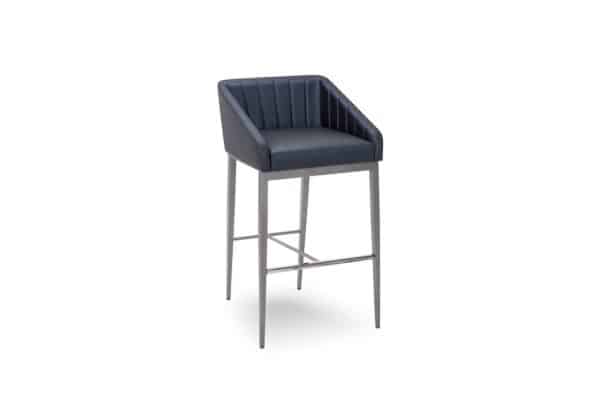
Comfort Isn’t Optional—It’s the Whole Point
A stool can look perfect and still fail completely if it’s uncomfortable.
Height plays a major role, but it’s not the only factor. The design of the stool itself matters just as much.
Think about how the seating will actually be used. Is it a quick coffee spot? A homework station? A place where guests gather for hours?
Comfort comes from a combination of elements:
- Proper seat height relative to the counter
- Footrests that align naturally with your legs
- Back support if the stools will be used for extended periods
If people are constantly shifting, leaning, or avoiding the stools altogether, something is off—and it’s usually a sizing or design issue.
How Style and Height Work Together
Height isn’t just functional—it affects the visual balance of your space.
Counter height seating tends to feel more open and understated. It keeps everything on a similar level, which works well in modern and transitional designs.
Bar height, on the other hand, introduces a layered look. It creates a visual break and can make a space feel more dynamic—but also more segmented.
Neither is better. It depends on what you want your space to feel like.
If your goal is a cohesive, flowing layout, counter height is usually the better fit. If you want definition and separation, bar height can deliver that.
Why Customization Solves Most Problems
Here’s the reality: most frustration around bar stools comes from trying to force a standard solution into a non-standard space.
That’s where customization changes everything.
With Casual Dining & Bar Stools, you’re not guessing or compromising. You can select the exact seat height, style, finish, and features that match your space and how you use it.
This matters more than people realize.
Instead of asking, “Will this work?” you’re deciding, “What works best?”—and building from there.
Customization is especially valuable if:
- Your counter height falls outside standard ranges
- You want to match existing wood tones or finishes
- You need specific features like backs, arms, or upholstery
It removes the trial-and-error process and replaces it with intention.
A Quick Reality Check Before You Buy
Before you make a final decision, take a step back and evaluate your space with fresh eyes.
Ask yourself:
- How do we actually use this area day to day?
- Who will be sitting here most often?
- Do we want this space to feel casual or more defined?
Too often, people buy based on a photo or trend rather than function. That’s how you end up with beautiful stools that don’t get used.
Your seating should support your lifestyle—not just your aesthetic.
The Bottom Line: Fit First, Style Second
If you remember one thing, make it this: fit comes first.
You can always adjust style with finishes, fabrics, and design details. But if the height is wrong, nothing else will fix it.
Counter height is the most versatile and widely used option for a reason—it works for everyday living. Bar height has its place, especially for defined or elevated spaces.
The right choice depends on your layout, your habits, and your priorities.
Get the measurements right, choose with intention, and invest in pieces that are built to fit your space—like those from Casual Dining & Bar Stools.
Do that, and your seating won’t just look good. It will actually work the way it’s supposed to.